Key Takeaways
- The full name ensures legal precision, geopolitical representation, and consistency with international standards on official UK documents such as visas.
- “United Kingdom of Great Britain and Northern Ireland” reflects all constituent regions and avoids misunderstandings or disputes in legal contexts.
- Official naming prevents ambiguity, aligns with international protocols, and ensures recognition across jurisdictions during travel and international agreements.
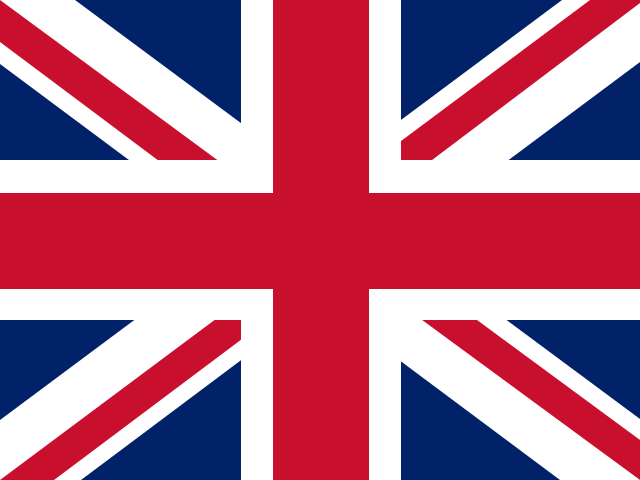
The inclusion of the full name, “United Kingdom of Great Britain and Northern Ireland,” on a UK visa often raises questions, especially for first-time applicants. Many individuals wonder why this lengthy name is used instead of simpler terms like “United Kingdom” or “UK.” To address this fully, it’s essential to delve into the formalities of government-issued identification, international law, and the geopolitical context of the United Kingdom ??. Each of these sheds light on the reasons behind this official naming convention.
The Official Name and Its Relevance
The term “United Kingdom of Great Britain and Northern Ireland” is the official and legal name of the sovereign state commonly known as the United Kingdom or UK. While “United Kingdom” may appear sufficient in everyday usage, official government documentation, including visas, passports, and treaties, often uses the full name to reflect its complete political and territorial identity.
The reason for its use on UK visas, therefore, is to maintain consistency with international standards and legal documentation. A visa is a legal document—it signifies permission granted by a country for a foreign national to enter, remain, or transit on its territory. The precision in wording ensures that no ambiguity arises between the smaller regions or states within the UK and similar-sounding regions elsewhere in the world.
Free toolDS-160 Form Filling Online Helper ToolWhat Does the Full Name Represent?
Let’s break down the components of this long formal name to understand what it represents:
1. United Kingdom: Stands for the union of countries within the kingdom.
2. Great Britain: Refers to the largest island in the British Isles, encompassing England ??, Scotland ?, and Wales ?.
3. Northern Ireland: Represents the region of the island of Ireland ?? that is still part of the United Kingdom.
The full name acknowledges all the union’s constituent countries and reflects the historical and political arrangements that define the country’s borders. This is crucial in legal texts like visas and passports, which may come under scrutiny in international border checks. Using the complete name avoids misunderstandings or disputes over the issuing authority of the visa.
Why Isn’t a Simplified Name Used on UK Visas?
Although the shorter terms “UK” or “Great Britain” are widely understood, they are considered informal and imprecise in legal contexts. Here’s why:
– The “United Kingdom” alone does not clarify that it includes Great Britain and Northern Ireland.
– Using “Great Britain” instead of the full name incorrectly excludes Northern Ireland, which would inaccurately describe the jurisdiction.
Given the legal nature of visas, it is imperative to include the complete name so that it is universally understood and accepted in all jurisdictions. Governments worldwide adhere to these naming conventions to avoid potential disputes while respecting the geopolitical sensitivities surrounding their nation’s territories.
The Importance of Consistent Naming in Official Documents
Using the full formal name across official documents such as UK visas not only standardizes governmental processes but also aligns with international protocols. For example, when UK visas are issued, they often need to correspond with treaties or legal agreements requiring specific designations of the issuing state. Uniform terminology helps facilitate global recognition.
The UK government also has formal agreements with other countries, and the full name may be explicitly required in such treaties. Listing “United Kingdom of Great Britain and Northern Ireland” eliminates ambiguity for foreign immigration officers unfamiliar with shorthand names like “UK.”
Practical Implications for Visa Applicants
For most applicants, the use of the full name has no bearing on the visa’s validity or their ability to use it effectively. Whether listed as “United Kingdom,” “UK,” or the full “United Kingdom of Great Britain and Northern Ireland,” the visa serves the same purpose. However:
– When filling out application forms or submitting supporting documents, it is advisable to use the official country name as a best practice to match the information exactly as it appears on the visa.
– Travelers must present the visa in conjunction with their passport, which is another document that likely contains the same officially recognized name.
This consistency ensures there are no discrepancies during international travel, whether at border control or during extended stays in the UK.
Context in an International Landscape
Globally, many other countries follow similar naming practices for their visas, passports, and official documents. For example:
– The formal name of Austria is “Republic of Austria” (Republik Österreich) on official documents.
– For Mexico, it is referred to as the “United Mexican States” (Estados Unidos Mexicanos) on legal texts.
Simply put, every country has a recognized, formal identity that goes beyond its commonly used name. The use of the full name underscores respect for sovereignty and proper handling of international agreements and protocols.
Geopolitical Considerations
The inclusion of Northern Ireland in the official name represents one of the most politically significant aspects of the United Kingdom’s identity. Given historical tensions on the island of Ireland and the longstanding negotiations to maintain peace (such as the Belfast Agreement of 1998), the name is a reflection of the political arrangements within the union. Leaving Northern Ireland out of the official name could politically alienate some groups, so its recognition in official texts, including UK visas, is viewed as essential.
At the same time, the inclusion of “Great Britain” ensures that no part of England, Scotland, or Wales is overlooked in the country’s formal identity. This balancing act is a reflection of centuries of governance and compromise within the UK.
Common Misunderstandings About UK Visa Titles
Despite its logical usage, some misunderstandings persist about the name’s presence on UK visas. Below are a few clarified points:
1. Does the name indicate where the visa is valid?
Yes. The visa permits entry to all parts of the United Kingdom ?? (including England, Scotland, Wales, and Northern Ireland) but does not automatically permit entry to dependencies like the Isle of Man or Channel Islands unless explicitly stated.
- Does it mean you will visit all parts of the United Kingdom?
No. The visa’s title simply reflects the issuing authority. Where you choose to travel within the UK depends on personal plans and requirements. -
Is seeing “United Kingdom” on the visa sufficient?
Absolutely. Immigration officers and officials fully understand all widely accepted names, but opting for the full legal title prevents any room for misinterpretation, particularly in areas with overlapping jurisdiction.
How Should Applicants Interpret This Name?
If you are applying for or have already received a UK visa, its title, “United Kingdom of Great Britain and Northern Ireland,” should simply be taken as a formal title. It serves no hidden purpose or added restrictions beyond emphasizing the complete scope of the issuing state. Applicants need only ensure their application aligns with the name’s precision when filling out documents.
Words of Advice for Travelers
For simpler travel and smoother immigration checks:
– Save a digital and printed copy of your visa in case additional verification is required during travel.
– Ensure all travel documents (e.g., passport and visa) are consistent with the correct names.
The UK Home Office provides detailed guidance on preparing for entry into the country and understanding visa types. Applicants can visit the Home Office’s official immigration and visas page for further clarification on visa requirements, rules, and travel tips.
Conclusion
The long-standing usage of the name “United Kingdom of Great Britain and Northern Ireland” reflects the UK ?? government’s commitment to precision, consistency, and legal clarity in its documentation. Far from just a historical relic, the name ensures that all parts of the union are accurately represented in official matters. For visa holders, this is neither an added burden nor a complicated factor. Instead, it is a reminder of the comprehensive nature of official processes designed to safeguard not only national integrity but also smooth international travel for everyone.
Why UK visas use the full official name
UK visas display the formal title, “United Kingdom of Great Britain and Northern Ireland,” instead of shorter terms like “UK” or “United Kingdom.” This choice reflects legal, geopolitical, and historical practices.
Why it matters: The use of the full name ensures accuracy in legal documents, prevents jurisdictional misunderstandings, and recognizes all parts of the UK, including Northern Ireland, in official contexts.
The big picture:
– The full name represents the UK as a sovereign state, acknowledging its union of England, Scotland, Wales, and Northern Ireland.
– Legal precision is critical for international recognition. Shortened names could exclude parts of the UK or create ambiguity in international border checks.
What they’re saying:
UK immigration authorities emphasize that using the full name aligns with international standards. The UK Home Office also advises travelers to ensure consistency between their visa and other travel documents.
Between the lines:
– “United Kingdom” without “Northern Ireland” could overlook part of the union.
– Using “Great Britain” excludes Northern Ireland entirely, which could spark political or legal complications.
By the numbers:
- The UK comprises four countries: England, Scotland, Wales, and Northern Ireland.
- The full title “United Kingdom of Great Britain and Northern Ireland” explicitly recognizes all of them.
State of play: For visa applicants, using the official name isn’t burdensome. It ensures clarity and avoids issues during travel or immigration checks. Travelers should match the official title with supporting documents.
Yes, but: Informally, terms like “UK” or “Great Britain” are widely understood. However, in legal and official documents like visas, precision and consistency are non-negotiable to avoid disputes.
The bottom line: The use of the full official name on UK visas ensures legal clarity, respects geopolitical sensitivities, and reflects the entirety of the United Kingdom. For travelers, it’s a technical formality that supports smoother international travel processes.
Learn Today
Visa: A legal document allowing a foreign national to enter, stay, or transit through a country under specific conditions.
Sovereign State: An independent entity with defined territory, permanent population, and a government capable of international relations.
Geopolitical: Relating to the influence of geography on politics, especially in terms of borders, territories, and international relationships.
Belfast Agreement: A 1998 peace accord resolving political conflicts in Northern Ireland, also called the Good Friday Agreement.
Territorial Identity: The unique political, historical, and cultural characteristics defining a specific country’s or region’s boundaries and governance.
This Article in a Nutshell
“Why does a UK visa feature the full name, ‘United Kingdom of Great Britain and Northern Ireland’? Precision. This official title ensures legal clarity, acknowledging England, Scotland, Wales, and Northern Ireland. While ‘UK’ suffices conversationally, exact wording avoids confusion internationally, highlighting unity and sovereignty across legal, historical, and geopolitical contexts. It’s formality with purpose.”
— By VisaVerge.com
?
Related Articles
01
United Kingdom Reinstates Visas for Colombian Travelers
→
02
US to UK Car Import: Step-by-Step Guide for Importing a Vehicle from the USA to the United Kingdom
→
03
UK Transit Visa: A Detailed Guide
→
04
Applying for an Artist Visa in the UK: A Guide for Exhibiting Artists
→
05
Discover American Expat Communities in the UK for a Thriving Expat Living Experience
→